

 By
By We have done number of treks in the Siran Valley in the Mansehra district of KP. These include to Musa ka Musalla and Khunda peaks, and to the Paleja plateau. We also did the Munro Trail trek earlier this year that partly goes through the Siran Valley. Sohni ka Sar means Sohni’s water pond in the local dialect. It is located in the Siran River’s catchment area, close to the Allai valley. So it can be approached from both the valleys (Siran and Allai). The water pond is sitting amidst mountains with heights ranging to 12800 feet or 3900 meters ASL.
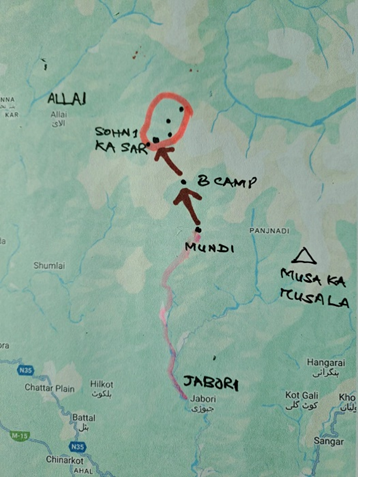
Trek Map
We attempted this trek last year in September but had to abort it as one of the trekker was taken ill. So this year myself, Asad and Imtiaz left Islamabad early on 24 August and we reached Mundi (in the upper Siran Valley) by 1130. It is the last stop on the road and the trek kick-off point. Our guide, Sumundar Khan, joined us enroute and the logistic team compromising two horses alongwith their owners met us in Mundi. Starting at a height of just under 7000 feet we trekked for about six hours over two climbs to reach the Base Camp on a meadow close to 10,000 feet or 3150 meters. Camp was set up and we had our dinner of brinjal, warm nans and tea. It was an adventurous night as one of our tents collapsed, perhaps due to faulty pitching
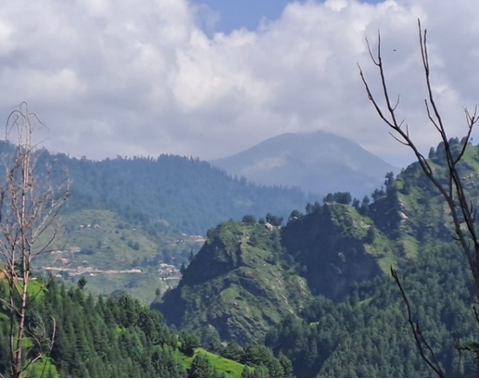
Sohni ka Sar seen from a distance
We took off early next morning. The climb took us over lush green ascending meadows to reach a picturesque saddle in the mountains. We then started the climb along a stony mountainside. The route skirted around one of the Sohni ka Sar mountains to reach the Pond. It was 910 meters or about 3000 feet of ascend that we did in two hours plus. We took pictures and were warned by a local of an impending rain. That luckily never came and we climbed two adjoining peaks. Hike to the third one would have taken us way off the return route, so we started the journey back. We had tea, refreshments and rest in the Base Camp which was to be relocated close to Mundi.
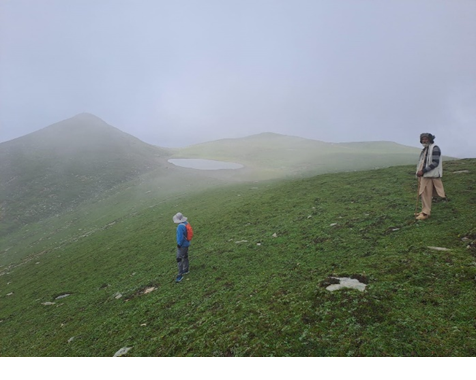
Sohni ka Sar in marginal weather
Having reached the new camp site by early evening we then decided to trek back to Mundi. One of our guides paced ahead to get the jeep. Luckily the jeep waited for us as we reached Mundi by nightfall. We trekked 32 kilometers in two days, mostly along ascends and descends. It was a picturesque setting with shepherds in their summer huts. They looked after us with servings of warm milk and lassi (buttermilk). We are grateful for their hospitality. Having done many treks in remote areas one comes to respect the cultural sensitivities of the local communities. One should be kind to them and they should be adequately compensated for their services.
I would make a case for promoting eco-friendly tourism in the Siran Valley which hosts scenic and safe trekking and outdoor recreational venues. It is easily approachable on the Mansehra – Shinkiari expressway. However, the tourism infrastructure is not developed and the local government’s patronage of such activities is largely missing. So is the private sector’s participation in promoting tourism. On the plus side, the touristic venues and the local environment retains its original flavor. It is not yet degraded by commercialism as is the case in the adjoining Kaghan and Naran valleys.
Having reached the new camp site by early evening we then decided to trek back to Mundi. One of our guides paced ahead to get the jeep. Luckily the jeep waited for us as we reached Mundi by nightfall. We trekked 32 kilometers in two days, mostly along ascends and descends. It was a picturesque setting with shepherds in their summer huts. They looked after us with servings of warm milk and lassi (buttermilk). We are grateful for their hospitality. Having done many treks in remote areas one comes to respect the cultural sensitivities of the local communities. One should be kind to them and they should be adequately compensated for their services.
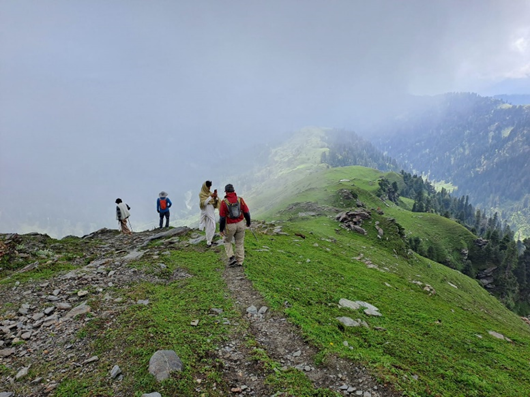
Returning along rolling meadows
I would make a case for promoting eco-friendly tourism in the Siran Valley which hosts scenic and safe trekking and outdoor recreational venues. It is easily approachable on the Mansehra – Shinkiari expressway. However, the tourism infrastructure is not developed and the local government’s patronage of such activities is largely missing. So is the private sector’s participation in promoting tourism. On the plus side, the touristic venues and the local environment retains its original flavor. It is not yet degraded by commercialism as is the case in the adjoining Kaghan and Naran valleys.